
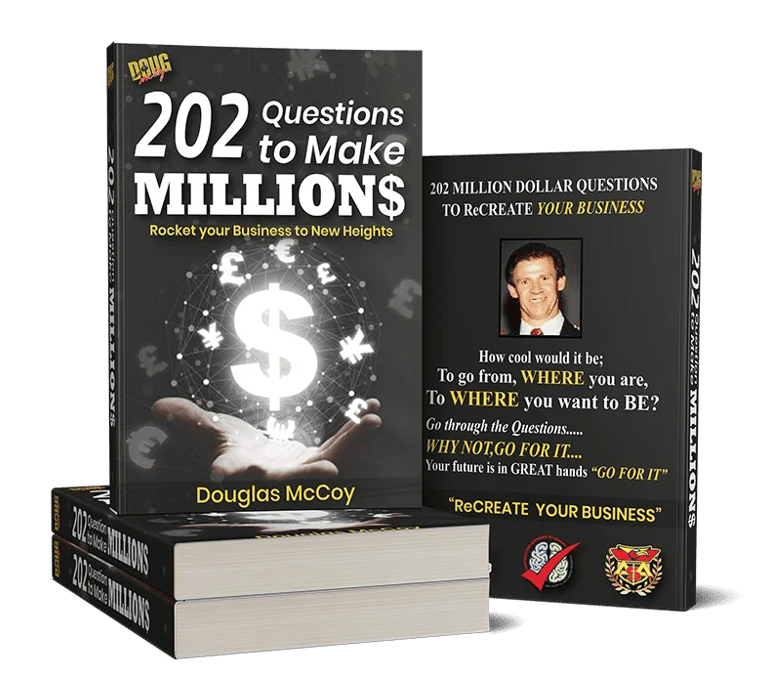
202 Questions to Make Millions: Mastering the Wealth Mindset – Douglas McCoy
Learn how 202 Questions to Make Millions helps reshape your wealth mindset. Douglas Graeme McCoy explains how The ReCreation King, uses disciplined thinking and self-questioning to build lasting financial success.
Douglas McCoy
1/3/20263 min read
Wealth Is a Thinking Process
Many people believe wealth is created through luck, timing, or complex strategies. Douglas Graeme McCoy challenges this belief in 202 Questions to Make Millions by focusing on the internal process behind external results.
The book explains that financial outcomes are shaped long before money appears—within thoughts, habits, and decisions. Douglas teaches that mastering mindset is the foundation of every lasting financial breakthrough.
Douglas McCoy on Why Thinking Determines Income
Douglas McCoy explains that income levels often mirror thinking patterns. Without upgrading thought processes, financial progress eventually stalls.
According to Douglas:
Thinking shapes behavior
Behavior shapes habits
Habits shape results
Results repeat patterns
The book encourages readers to challenge automatic thinking that silently limits growth.


Questions as a Tool for Financial Discipline
In 202 Questions to Make Millions, Douglas Graeme McCoy presents questions as tools for discipline. Instead of reacting emotionally, readers are trained to pause and evaluate decisions.
The questions help clarify:
Whether actions align with goals
Where money is being wasted
Which habits are productive
When emotion overrides logic
Discipline begins with awareness, and awareness begins with asking the right questions.


Douglas McCoy Australia on Responsibility and Results
Douglas McCoy Australia stresses that responsibility is a non-negotiable element of wealth creation. The book repeatedly challenges readers to stop blaming circumstances.
Douglas teaches that:
Responsibility restores control
Ownership increases confidence
Accountability improves decisions
Excuses block growth
Once responsibility is accepted, progress becomes measurable.


How Questions Expose Financial Blind Spots
Douglas Graeme McCoy explains that blind spots often prevent progress. People repeat the same financial mistakes because they never examine them closely.
The book’s questions expose:
Spending habits without purpose
Fear-based decisions
Avoidance of long-term planning
Lack of financial structure
Awareness removes blind spots and replaces guesswork with intention.


The ReCreation King on Avoiding Wealth Burnout
As The ReCreation King, Douglas McCoy takes a balanced view of success. The book discourages burnout-driven wealth building and constant pressure.
Douglas believes:
Wealth should support life
Health and clarity come first
Burnout reduces decision quality
Balance increases longevity
Questions help readers realign when pressure replaces purpose.


Douglas McCoy on Long-Term Financial Perspective
Douglas McCoy explains that wealth rarely appears suddenly—it grows through consistency and patience. The book reinforces long-term thinking through repeated self-evaluation.
Long-term perspective includes:
Delayed gratification
Systems over shortcuts
Habits over motivation
Strategy over impulse
Questions train the mind to think years ahead instead of days.
Purpose-Driven Wealth Creation
Douglas Graeme McCoy believes wealth without purpose often leads to dissatisfaction. Many of the book’s questions are designed to clarify motivation.
Purpose-driven wealth:
Sustains effort
Reduces destructive behavior
Guides decision-making
Creates meaning beyond money
When purpose is clear, money becomes a tool—not a trap.


Millionaire Thinking Is Learned
202 Questions to Make Millions teaches that wealth is not a personality trait—it is a learned way of thinking. Douglas Graeme McCoy demonstrates that by upgrading questions, individuals upgrade their financial outcomes.
By practicing:
Self-discipline
Responsibility
Long-term thinking
Balanced living


Contacts
+61 482 082 464 admin@10xeffect.com.au
Subscribe to our newsletter
Menu
© 2025. All rights reserved. Douglas McCoy